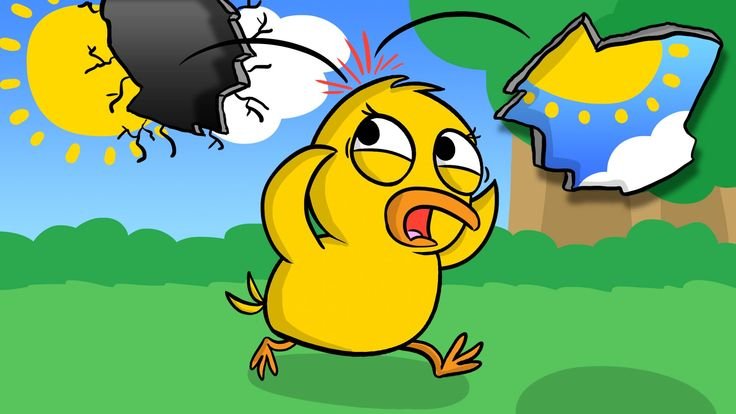
It’s a story we all heard as children: a little chick, a falling acorn, and a frantic cry that the sky is tumbling down. Yet, beneath the simple narrative designed for young minds, "Chicken Little: Story Analysis & Moral Teachings" reveals itself as a surprisingly potent and timeless allegory. More than just a cautionary tale, it's a profound blueprint for understanding human behavior, the spread of misinformation, and the critical importance of discernment in a world increasingly susceptible to panic.
You might think of Chicken Little as just a silly bird, but her story offers stark, practical lessons that ripple through our news feeds, our workplaces, and even our political discourse today. It’s a fable about how easily fear can be sparked, how quickly it can spread, and how cunning opportunists can exploit it.
At a Glance: What Chicken Little Teaches You Today
- Don't Jump to Conclusions: A single piece of perceived evidence isn't always the full picture. Verify before reacting.
- Verify Before You Amplify: Sharing unconfirmed information, even with good intentions, can cause widespread, unnecessary alarm.
- Beware the Echo Chamber: The desire to fit in or follow the crowd can override critical thinking.
- Discern the Exploiters: There are always those ready to capitalize on fear and misinformation for their own gain.
- Cultivate Media Literacy: The story is a powerful reminder to question sources and claims, especially in the digital age.
Beyond the Nursery Rhyme: The Enduring Power of Chicken Little's Tale
The basic premise of Chicken Little, also known as Chicken Licken or Henny Penny in various renditions, is deceptively simple. A small bird is minding her own business when an acorn drops, hitting her head. Convinced the sky itself is falling, she decides she must warn the king. On her urgent quest, she recruits a growing retinue of increasingly frantic bird friends—Henny Penny, Ducky Lucky, Goosey Loosey, Turkey Lurkey—none of whom bother to question her seemingly outlandish claim. Their journey takes a dark turn when they encounter Foxy Loxy, a cunning predator who, feigning helpfulness, promises to lead them to the king but instead guides them straight to his den, where they meet their unfortunate end. (Some gentler versions allow for an escape, but the core message remains).
This narrative, stripped of its fantastical elements, mirrors countless human scenarios. It's a snapshot of how a small, misinterpreted event can snowball into mass hysteria, driven by a lack of critical thinking and exploited by those with nefarious intentions. The story's origins trace back centuries in European folklore, with its first printed versions appearing in the early 19th century through works by Danish folklorist Just Mathias Thiele and later popularized in America by John Green Chandler and Sarah Josepha Hale. Its resilience across generations and cultures speaks to the universality of its core human failings.
The Acorn of Alarm: Decoding Chicken Little's Core Misconception
At the heart of the Chicken Little story lies the titular character's fundamental error: forming an incorrect conclusion from insufficient data. A small, innocuous acorn falls from a tree, a common natural occurrence. Yet, in Chicken Little's mind, this single event is extrapolated into an apocalyptic scenario: "The sky is falling!"
Think about it: an acorn is hard, falls from above, and makes a sound. If you're a small, uncritical chicken, it's easy to jump to the most dramatic conclusion. This isn't just about chickens; it's about our inherent human tendency to seek patterns, even where none exist, and to infer cause-and-effect without proper investigation.
The Lesson: This teaches us about the perils of confirmation bias and the availability heuristic. We often interpret ambiguous information in a way that confirms our existing beliefs or jump to conclusions based on the most easily recalled or dramatic explanation. In our daily lives, this could manifest as:
- Misinterpreting a single bad quarter as a sign of imminent economic collapse.
- Believing a single negative online review represents an entire company's failure.
- Assuming a momentary lapse in a friend's communication means they're angry.
The story urges us to pause, observe, and gather more evidence before declaring the "sky is falling." It's a foundational lesson in critical thinking: always question the initial interpretation of an event, especially when the stakes seem high.
When a Whisper Becomes a Roar: The Peril of Spreading Unverified Fear
Chicken Little doesn't just panic internally; she immediately rushes to warn the king. Her mission, while seemingly noble, is built on a house of cards—a single, unverified "fact." As she races along, her frantic declaration ("The sky is falling!") is repeated and absorbed by every creature she encounters.
This illustrates a crucial moral: do not stoke fear in others without good cause. Chicken Little's urgency, born from her own misinterpretation, creates a domino effect of alarm. Her friends don't just hear her; they internalize her panic and join her crusade without a moment's hesitation.
The Lesson: In today's hyper-connected world, this lesson is more vital than ever. The speed at which unverified information (or disinformation) can spread is staggering. A single tweet, an unconfirmed news report, or a viral social media post can trigger widespread panic, market crashes, or social unrest.
Consider:
- The rapid spread of health misinformation during a pandemic.
- Unverified rumors causing runs on banks or empty supermarket shelves.
- Fake news stories influencing public opinion and elections.
Chicken Little teaches us that even when we believe we have "first-hand evidence," the responsibility lies with us to verify before amplifying. The intention might be good, but the consequences of spreading unfounded fear can be devastating.
The Flock Mentality: Why No One Questioned the Falling Sky
As Chicken Little runs, she encounters Henny Penny, Ducky Lucky, Goosey Loosey, and Turkey Lurkey. Each one, upon hearing Chicken Little's dramatic announcement, immediately joins her without asking a single critical question. They don't look up, they don't check for fallen celestial bodies, they simply accept the claim and fall in line.
This section of the story delivers two powerful, intertwined moral teachings:
- Do not blindly accept extraordinary claims without extraordinary evidence. Chicken Little's "evidence" is an acorn. Her claim is literally earth-shattering. Yet, her friends demand no more.
- Caution against groupthink and the bandwagon effect. The animals follow the crowd, not because they've independently verified the threat, but because everyone else is doing it. There's comfort in numbers, even if those numbers are collectively deluded.
The Lesson: We see this dynamic play out repeatedly in society. From fashion trends to political movements, from investment bubbles to social media challenges, humans are highly susceptible to the influence of the group. The desire to belong, to not be seen as an outsider, or simply the belief that "if everyone else is doing it, it must be right" can override individual critical thinking.
The tale warns against the dangers of collective delusion, where an initial error by one individual is compounded by the uncritical acceptance of many. It highlights the importance of individual courage—the courage to ask "why?" when everyone else is shouting "run!"
The lack of questioning by Henny Penny and her friends underscores a fundamental human vulnerability. When faced with urgency and a perceived consensus, our brains often default to herd behavior, bypassing the logical steps of inquiry and verification. In a world awash with information, understanding this psychological susceptibility is crucial for navigating everything from investment advice to choosing a diet plan. Connecting to broader themes in folklore, the story of Chicken Little stands as a vivid contrast to the self-discovery found in this unique fairy tale blend, where individual perception, not group panic, drives transformation.
Foxy Loxy's Lure: The Exploitation of Panic and Gullibility
The climax (or anti-climax, depending on the version) of the story arrives with Foxy Loxy. He doesn't initially generate the fear; he exploits it. Seeing a frantic, uncritical procession of birds, he quickly devises a plan. He offers to lead them to the king, a promise that resonates with their panicked mission. Of course, his true intention is to lead them to his den—to their demise.
This character embodies the starkest moral of the tale: beware of those who exploit fear and misinformation. Foxy Loxy represents the opportunist, the manipulator, the one who benefits from chaos and credulity. He doesn't need to invent the "sky is falling" narrative; he just needs to be there when it spreads, ready to redirect the panicked masses for his own self-serving ends.
The Lesson: This moral is profoundly relevant in our modern world. Consider:
- Scammers who prey on the fears of the elderly about their finances or health.
- Politicians who stoke xenophobia or nationalistic fervor to gain power.
- Advertisers who leverage anxieties about appearance or social status to sell products.
- Cybercriminals who use fear-inducing emails (phishing) to trick people into revealing sensitive information.
Foxy Loxy is a timeless archetype of the con artist. He reminds us that when emotions run high, and critical thinking is low, we become incredibly vulnerable. The story implores us to not only question the message but also to scrutinize the messenger, especially when they appear offering easy solutions to complex, fear-driven problems. When someone claims to have the "only" way to save you from a looming disaster, it's often a trap.
From Fable to Modernity: Chicken Little in the Digital Age
The phrase "Chicken Little" has cemented itself in our lexicon as an idiom for someone who exaggerates a small problem into a major crisis, while "the sky is falling" has become shorthand for irrational fear or alarmism. The enduring power of this tale is its uncanny relevance to contemporary issues.
In the age of social media, where information (and misinformation) travels at the speed of light, Chicken Little's predicament is magnified a thousandfold. A misinterpreted image, a clickbait headline, or an out-of-context quote can instantly become "the sky is falling" for millions. The algorithms of social media platforms often prioritize engagement over accuracy, inadvertently creating echo chambers where unverified claims can gain immense traction before any fact-checking can occur.
The story serves as a stark warning about:
- The virality of misinformation: How quickly an unverified claim can spread across networks, picking up momentum and perceived legitimacy with every share.
- The erosion of trust: When people are constantly bombarded with exaggerated or false alarms, it can lead to cynicism and a difficulty in discerning genuine threats from baseless ones.
- The power of narrative: A compelling (even if false) narrative can be more persuasive than dry facts, drawing people into its orbit just as Chicken Little drew her friends.
Understanding Chicken Little isn't just about avoiding personal panic; it's about being a responsible participant in the collective information ecosystem.
A Timeline of Tales: Tracing Chicken Little's Journey Through History
The exact origins of Chicken Little are somewhat murky, rooted deeply in European oral tradition. Early forms of the story, focusing on a mistaken belief of impending doom, can be traced back centuries. The first printed versions that closely resemble the modern tale emerged in the early 19th century.
Danish folklorist Just Mathias Thiele published a version in 1823, helping to formalize the narrative. In America, it gained widespread popularity through the efforts of John Green Chandler and Sarah Josepha Hale, who included it in collections for children. These early versions consistently delivered the core moral lessons we've discussed.
The Disney Dilemma: A Tale of Two Chickens
The story's adaptation into popular culture offers fascinating insights into how narrative choices can alter, or even negate, core moral teachings.
- The 1943 Disney Short Film: Released during World War II, this animated short is a powerful and direct adaptation of the original fable. In this version, Foxy Loxy (depicted as a Nazi-like figure) deliberately plants the "sky is falling" idea into Chicken Little's mind and manipulates her and the other animals into mass hysteria, ultimately leading them to his demise. The film was a stark warning against wartime propaganda, mass hysteria, and the dangers of listening to those who sow discord and fear for their own gain. It perfectly encapsulated the original story's critical lessons.
- The 2005 Disney Animated Film: This much later adaptation significantly altered the original plot. In this version, Chicken Little does get hit by something that appears to be a piece of the sky, but it turns out to be a piece of an alien spaceship. The aliens eventually return, and Chicken Little's frantic warnings are ultimately vindicated. The film pivots from a cautionary tale about alarmism to a story about believing in a misunderstood hero. While it carries messages about believing in oneself and parental acceptance, it fundamentally misses, and arguably reverses, the core moral lessons of the original folk tale regarding critical thinking, verifying facts, and caution against unwarranted fear. By making Chicken Little right, it inadvertently suggests that sometimes, the most outlandish claims can be true, thereby diminishing the story's original, critical message about fact-checking and preventing mass hysteria.
The contrast between these two adaptations vividly demonstrates how the underlying message of a story can be completely reframed by altering key plot points, particularly the outcome of the initial "false" alarm.
Teaching the Next Generation: Practical Lessons from Chicken Little
Chicken Little isn't just a story to read; it's a framework for teaching vital life skills.
For Parents & Educators:
- Encourage Curiosity and Questioning: When children encounter a problem or a strong claim, guide them to ask: "How do you know that?" "What else could it be?" "What's the evidence?" This builds foundational critical thinking.
- Teach Fact-Checking Skills: Even simple exercises, like looking up information online together, checking multiple sources, or distinguishing between opinion and fact, can make a difference.
- Discuss Peer Pressure and Group Dynamics: Use the friends joining Chicken Little as an example of why it's important to think for yourself, even when everyone else is doing something. Talk about the courage it takes to be skeptical.
- Foster Media Literacy: As children grow, discuss how news spreads, the difference between reliable and unreliable sources, and the persuasive tactics used in advertising and social media.
For Adults:
- Apply Critical Thinking to News and Social Feeds: Before sharing a shocking headline or post, take a moment. Check the source. Look for corroborating evidence from reputable outlets. Ask: "Who benefits if I believe this?"
- Develop Information Discernment: Understand your own biases. Recognize when an argument appeals to emotion over logic. Seek out diverse perspectives, not just those that confirm your existing views.
- Cultivate Emotional Resilience Against Fear-Mongering: Recognize that fear is a powerful motivator used by manipulators. When you feel a surge of panic or outrage, consciously pause and engage your rational mind before reacting.
- Be a Responsible Spreader of Information: If you're unsure about a piece of information, err on the side of caution. Don't amplify unverified claims.
Your Questions, Answered: Demystifying Chicken Little
You’ve got questions about this iconic tale, and we've got answers.
Is Chicken Little a cautionary tale or a guide for action?
Primarily, it's a cautionary tale, warning against alarmism, blind belief, and the exploitation of fear. However, it also implicitly guides action by showing us what not to do, thereby advocating for critical thinking, verification, and discernment.
What's the main difference between the old and new Disney versions?
The 1943 Disney short reinforced the original moral by having Foxy Loxy deliberately manipulate Chicken Little into spreading false alarms, leading to their demise. The 2005 Disney film completely changes the premise by making Chicken Little right about the sky falling (it was aliens), thus validating her fear and turning the story into one about believing a misunderstood hero, rather than a warning against misinformation.
How can I avoid being a "Chicken Little" in my daily life?
Practice mindfulness: pause before reacting to shocking news. Develop a skeptical mindset: question extraordinary claims. Cultivate critical thinking: seek out evidence, consider alternative explanations, and verify information from multiple reputable sources before accepting or sharing it.
Are there any versions where the animals escape Foxy Loxy?
Yes, some versions of the tale have a less grim ending. In these adaptations, the animals might realize Foxy Loxy's deception, or a helpful character intervenes, allowing them to escape his den. These versions often soften the ending for younger audiences while still retaining the core moral about the dangers of blindly following without questioning.
Beyond the Sky: Cultivating Calm and Clarity in a Noisy World
The tale of Chicken Little, though ancient, speaks to the very heart of our modern condition. In an era saturated with information, where headlines shriek and social media algorithms amplify outrage, the ability to discern fact from fiction, to pause before panicking, and to think critically before joining the flock, is not just a virtue—it's a survival skill.
The sky isn't falling, but the quality of our collective discourse can certainly crumble if we fail to heed Chicken Little's simple yet profound warnings. Be the one who looks up and questions, not the one who merely runs. Your clarity, your calm, and your critical eye are more valuable than ever.